
Custer County VINE Coverage
Idaho VINE is the statewide victim information and notification service sponsored by the Idaho Sheriffs' Association. Both the Custer County Sheriff page and the county court page link VINELink. That double local referral is especially useful because the sheriff publishes no online jail roster or recent-release feed.
Coverage must still be read carefully. County jail booking interfaces and the Idaho Department of Correction feed are distinct streams. Idaho also supports court-event notification. A registration tied to one county custody record should not be assumed to carry into an IDOC record or a court case. Search and register against the matching record in each relevant system.
VINE is built for timely awareness. It may report custody status, location, and an event such as release or transfer. It does not replace a certified court order or release sheet. A VINE release means departure from the custodian named on that record, not proof that no other agency holds the person.
Search Custer County VINE
Begin with the person, not a broad list. VINELink is useful for a specific-name check and alert registration. It is not Custer County's missing 24-hour or 72-hour roster. Compare every available identifier because common names and separate custody episodes can create more than one result.
- Open VINELink and choose Idaho.
- Select the person or custody search rather than a court-event search.
- Enter the name or identifier available to you.
- Compare the returned identifiers, agency, and location before opening a match.
- Read the custody status and latest event on the matched record.
If more than one person appears, do not select by name alone. Use age, ID, agency, or another displayed fact. If no result appears, check spelling and alternate name forms, then try the separate IDOC search if state custody is plausible. The full Custer County released inmate search provides the broader fallback chain.
No result is inconclusive. The person may be outside a participating feed, entered under another name form, transferred, released before the searchable span, or held by a different custody system.
Custer VINE Release Fields
The exact fields vary by participating agency and record type. Read only what the matched record actually displays. In particular, do not convert an IDOC “scheduled termination date” into a guaranteed physical release date. Idaho corrections uses distinct status and date terms.
| VINE item | How to read it |
|---|---|
| Name and identifier | Helps distinguish the correct person and custody record. |
| Custody status | Shows the status reported by the named data source. |
| Agency or location | Identifies the custodian or facility tied to the event. |
| Event type | May state release, transfer, or another custody change. |
| Event date or time | Shows when the service says the reported event occurred. |
A reported release should prompt one more question: release to where? Community release, an IDOC commitment, another county warrant, federal custody, and immigration custody all end one agency's control in different ways. Ask the originating sheriff or corrections office for the underlying record when the distinction matters.
For a state prisoner, the IDOC resident/client search may show statuses such as incarcerated, released to supervision, or discharged. Those terms do not apply automatically to a Custer County jail-only booking.
Register Custer Release Notifications
Register only after opening the correct record. Idaho VINE may offer phone, text, or email channels. The available choices can vary. A phone registration uses a four-digit personal identification number, or PIN, so the recipient can acknowledge the automated call.
- Open the matched Custer County or IDOC custody record.
- Select notifications and choose the offered phone, text, or email method.
- Enter the contact details carefully.
- For a phone alert, create and retain the four-digit PIN.
- Save or confirm the registration and follow any verification prompt.
- When an automated call arrives, enter the PIN to acknowledge it.
IDOC states that unacknowledged calls repeat every two hours for up to 48 hours. Answering the call is not enough if the system requests the PIN. Keep registration details private and update the contact method if a phone number or email address changes.
Assistance is available through Idaho VINE at 1-866-984-6343, 24 hours a day. IDOC Victim Services can also be reached at (208) 605-4774 for its part of the state corrections process. These channels do not turn a notice into a certified record.
Custer VINE Limits and Proof
VINE data depends on transfers from participating agencies, so delay and error remain possible. The service does not cover federal Bureau of Prisons custody. It should not be used to prove that no other custodian holds the person, and it is not a substitute for a signed court order.
For Custer County Jail, call the sheriff at (208) 879-2232 or request the release record. For a state prison or IDOC supervision case, compare the IDOC resident/client record and request IDOC records when needed. For a federal case, use the Bureau of Prisons locator. For immigration custody, use the ICE Online Detainee Locator and Detention Reporting and Information Line.
A court-event alert serves another role. It can notify the registrant about proceedings, but it does not directly show the person's movement through a jail door. Use iCourt for the docket and obtain the operative order when legal authority is the question.
Why Custer Links VINE Twice
Custer County's sheriff and court pages both point to VINELink. That is a distinctive local strength in a county with no public jail roster. The sheriff link helps route custody questions. The court link reflects the separate court-notification function. Together they make VINE visible from two official paths without turning it into a historical booking archive.
The Custer County Sheriff page documents the local referral, while the Idaho Sheriffs' Association explains statewide jail coverage. The same person can appear in a county feed and later in an IDOC feed, but registrations are record-specific.
The Idaho VINE coverage page is shown below as interface evidence for the state's notification layer.
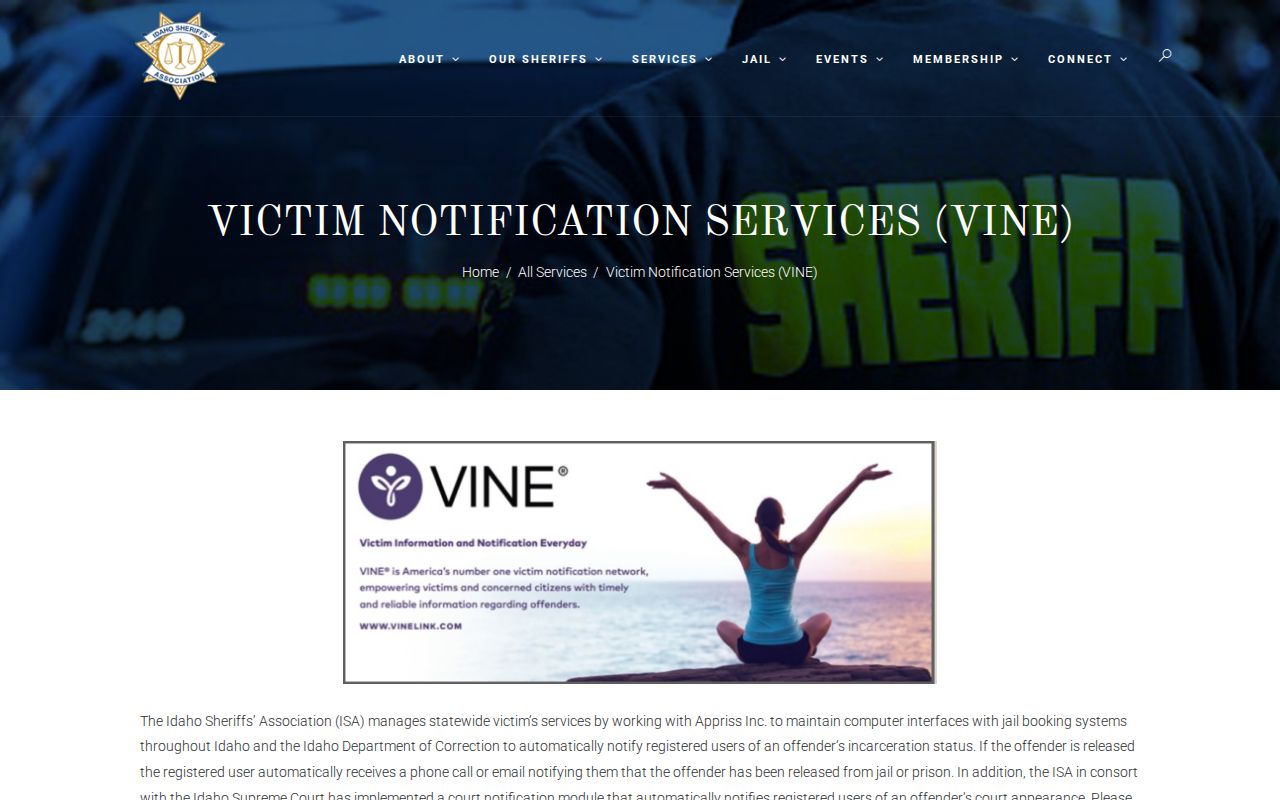
The captured source supports the use of Idaho VINE for notification. It does not certify the details of a specific release.
Register again when the custody layer changes if a matching new record is available. Never assume a county alert automatically follows an IDOC commitment, a court case, or a later return to custody.
Open the Idaho VINE Search
VINELink begins with state selection and a person/custody search. Choosing Idaho matters because each state's implementation and participating data streams differ. A national landing page does not remove the need to verify the local agency.
The official VINELink service provides the Idaho selection and search interface shown here.
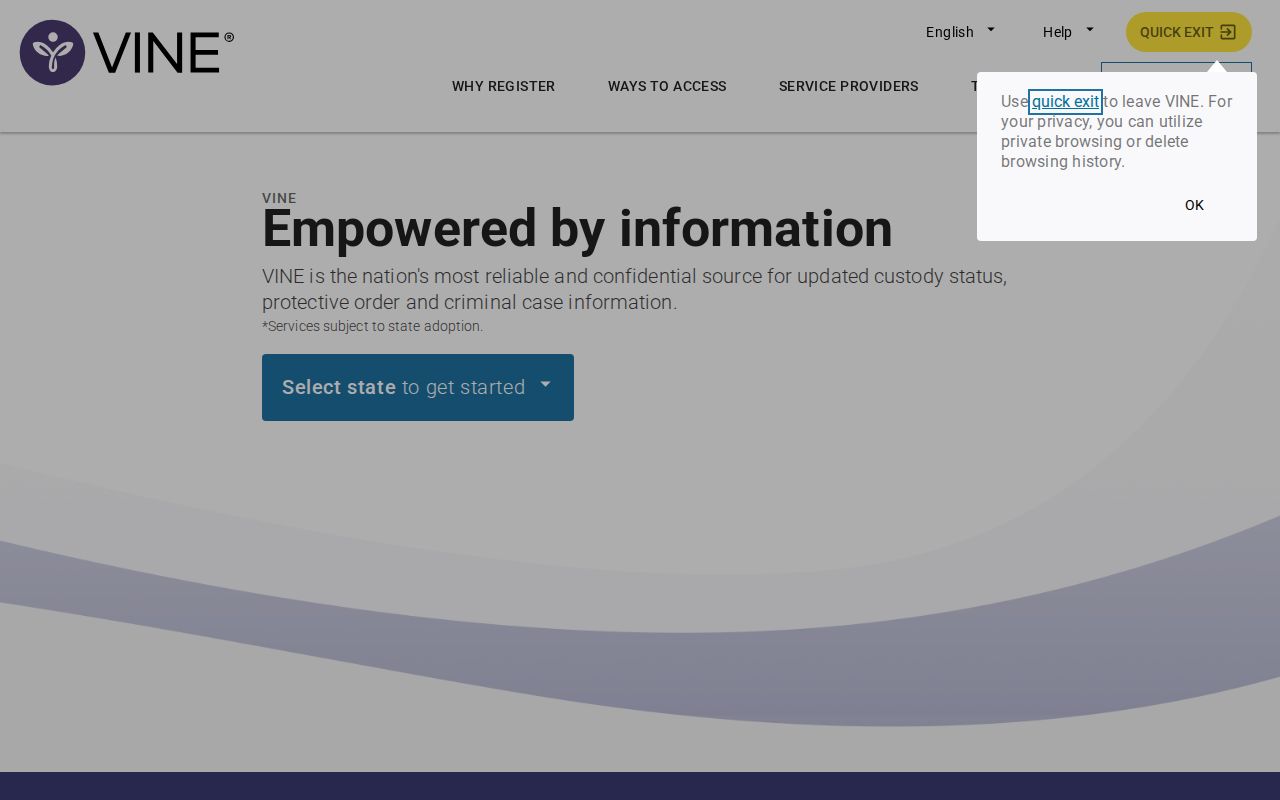
After state selection, use the person search and compare the returned custodian. The screen is a starting point, not proof that every past Custer County booking remains searchable.
For a qualifying registry record, Idaho's sex offender registry is a different system with its own scope and current registry data. It should not be confused with VINE custody status. Likewise, IDOC's public offender search has its own currency warning and status vocabulary.
Confirm Custer VINE Events
Build a short verification chain after an alert. Save the event time and named agency. Contact that agency for immediate clarification. Request the underlying record if a lasting document is needed. Check the court file when an order may explain the change.
| Alert says | Follow-up |
|---|---|
| Released from Custer County Jail | Ask whether release was to the community or another custodian. |
| Transferred | Identify and search the receiving agency. |
| IDOC released to supervision | Use IDOC status and the correct probation and parole district. |
| No result | Try name variants and the appropriate separate custody locator. |
Parole means conditional community release from a prison sentence. Probation is court-ordered supervision that may occur instead of, or after, local confinement. Discharge means an agency has ended the relevant sentence or supervision status. None of those terms should be inferred from a bare county jail disappearance.
The Custer sheriff record remains the documentary route for a county release. IDOC records govern state corrections status. Federal and immigration agencies control their own custody facts. Keeping those layers separate prevents the most common VINE error.
Custer VINE and IDOC Records
A person committed from Custer County to IDOC has moved into a state corrections layer. Search the IDOC resident/client system by last name, first name, or IDOC number. Its public results can include several statuses, including discharged. Open the matching detail record and read the agency's own labels.
IDOC uses “scheduled termination date” on its public landing page. That term is not a universal promise of the day someone will walk out of a facility. A detail record can also say “Released to Supervision,” which means community supervision rather than full discharge. VINE notice should be compared with those IDOC fields.
County VINE and IDOC VINE are separate data streams. A registration made during a Custer County Jail stay may not follow the person into IDOC. Find the new state record and register there if the option is offered. The same rule applies if the person later returns to county custody.
IDOC also warns that online information may not be fully current. Use its record for state status, then contact the agency or request records when an exact event requires proof.
Custer VINE Court Notifications
Idaho supports court-event notification in addition to custody notice. Custer County's court page links the service, but a court registration and custody registration are different. Select the feature that matches the event sought and keep the case number with the registration.
A hearing notice can help someone follow a pending case. It does not state that Custer County Jail has completed a release. A custody alert can report movement. It does not explain every legal term in the court order. Use both only when both questions matter.
Search iCourt for the public docket and obtain the relevant order from the clerk when documentary court proof is needed. Custer County Magistrate Court covers misdemeanor and traffic matters, while District Court covers felony matters. That case level helps identify the correct local court path.
If the court file is restricted, VINE does not override that access limit. Likewise, a court notice does not make a confidential jail field public. Each source remains subject to its own rules.
When Custer VINE Is Silent
Silence has several possible causes. The registration may be tied to the wrong person, old custody episode, or county stream. The contact method may have changed. An alert may still be pending because the source agency has not transferred data. The person may also be held by a system VINE does not cover.
First reopen the record and confirm the identifier and agency. Next review the chosen phone, text, or email method. For phone calls, keep the four-digit PIN ready so the alert can be acknowledged. Call the VINE assistance number when the registration cannot be confirmed.
Then check the originating custodian directly. Use the Custer County Sheriff for local jail status, IDOC for state corrections, BOP for federal prison custody, and ICE for immigration detention. A federal or ICE result will not be supplied by VINELink.
Do not treat a missing alert as proof that no release or transfer occurred. Timely awareness works best when paired with the responsible agency's record.