
Custer 72-Hour Feed Status
Custer County publishes no official rolling 72-hour release list. The sheriff page has no live roster or recent-release table. The statewide jail directory also says Custer County Jail has “No website.” As of July 16, 2026, there is no feed URL, update cadence, retention span, photo column, or set of displayed release fields.
A three-day inquiry still has value. It gives the records custodian fixed start and end dates. That wider span can capture events missed by a same-day call, especially when a weekend, holiday, or later data entry separates the physical release from the record update. The sponsored search above is not a county jail feed and must not be treated as one.
Check Custer Three-Day Releases
Set the time boundary before contacting the county. A request for “recent releases” is less precise than one naming the first date, last date, and record sought. Use the same range when checking VINE events and the court docket. Keep agency names with every result.
- For an event limited to today, begin with 24-Hour Releases.
- Search the named person in Idaho VINE and record the custodian and event date.
- Ask the sheriff for existing release records covering the exact three-day period.
- Search iCourt for a bond, dismissal, judgment, or other court action.
- If the record shows transfer, follow the locator for IDOC, federal custody, or immigration custody.
The sheriff can address current local custody by phone at (208) 879-2232. A call is useful when time matters. A written release sheet is the better path for a lasting record. Neither source should be stretched beyond the facts the office actually confirms.
Custer Three-Day Fields to Request
Because no online list exists, these are request targets rather than displayed columns. Existing county records may use other labels. Some material can be withheld or redacted under Idaho law, and the sheriff does not have to create a new report.
| Requested field | What it can establish |
|---|---|
| Name and booking number | Separates people and distinct jail episodes. |
| Release date and time | Places the event inside the requested period. |
| Release basis or authority | May reflect bond, a court order, dismissal, or a completed term. |
| Releasing facility | Names the custodian whose control ended. |
| Destination or receiving agency | Distinguishes community release from transfer. |
Ask for the existing record kept by the sheriff and give any known booking or case number. If a response cites a court order, carry the case number into iCourt. A jail record documents the custody event. The court file supplies the more durable account of the legal action behind it.
Custer Weekend Release Checks
Custer County publishes no weekend feed and no official jail release clock. A holiday or weekend can separate the time a person physically leaves from request intake, VINE data transfer, or a later court docket entry. The county records form says an after-hours submission is treated as received on the next working day. That rule applies to request intake, not to the release itself.
Keep event time and publication time separate. VINE may announce a custody change before a requested jail sheet arrives. A court order may explain why the person could leave, yet the docket is not a live log of movement through the jail door. For one known person rather than everyone in a three-day span, use the full process for Custer County released inmates.
The sheriff webpage and records form publish different office schedules. Neither source states that releases happen only during those hours. Treating office access hours as a release timetable would create an unsupported local fact.
Custer Three-Day Request Route
Use the county's writable Public Records Request form and identify a tight three-day range. The form lists email, mail, fax, and in-person delivery. Custer County may charge actual copying costs after more than 100 pages, eligible labor after two person-hours, and may require prepayment. Those thresholds do not establish a fee for every request.
The form's media procedure calls for an unopened 16GB thumb drive, a $2 processing charge, and prepaid return postage for photo or video delivery. A basic release sheet may not involve media, so request only the records needed. Broad wording can add search time without making the answer clearer.
Idaho VINE is the timely person-specific fallback. iCourt is the durable disposition route. The IDOC resident/client search is relevant only after entry into state corrections jurisdiction. Federal and immigration locators cover other custodians. A Custer County release can therefore be community release or the start of another custody layer.
Custer Has No Three-Day Roster
The official sheriff page supplies office contacts, the public-record route, and a VINE link, but no roster. The Idaho Sheriffs' Association directory reports eight rated beds, an average daily population of three, and “No website” for Custer County Jail. That small official scale helps explain why an urban-style three-day dashboard should not be assumed.
The statewide jail directory documents this local web-status finding.
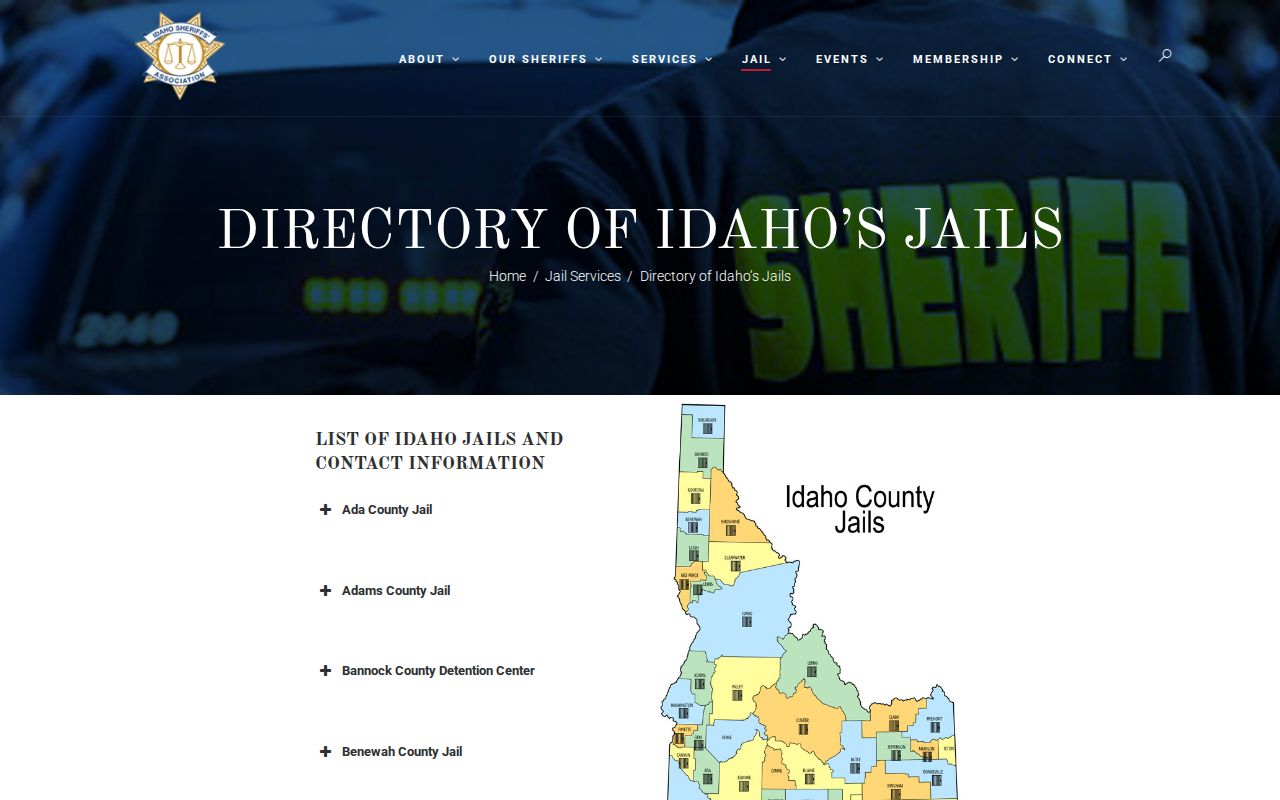
The captured row supports the absence finding. It does not contain a three-day list of names and should never be presented as one.
No sheriff mobile app is advertised. The sheriff links Facebook, but research did not establish that page as a complete or systematic release archive. A post about one incident cannot substitute for a bounded record request covering all three days.
Custer Releases Cross Custody Layers
A missing local result remains ambiguous across a three-day span. Bond, dismissal, time served, IDOC commitment, another warrant, a federal hold, or an immigration transfer can each end Custer County custody. The word “released” must therefore be tied to the named custodian.
- Community release
- The person leaves confinement, though court or agency supervision may follow.
- Transfer
- One custodian hands the person to another.
- Discharge
- An agency ends a sentence or supervision status under its own record terms.
- Detainer
- Another agency asks for added holding or transfer after local authority ends.
An ICE detainer, for example, can request up to 48 additional hours after the ordinary release point. A local disappearance followed by ICE custody is a transfer, not proof of community release. Confirm it through the receiving agency's locator and reporting line.
VINE, the sheriff record, the court order, and any receiving locator should be compared by agency and date. No one source covers every layer. That is why a three-day search must preserve custody context rather than display an invented roll of names.
Custer Three-Day Record Timing
The county form states that public-record requests are ordinarily granted or denied within three working days. If more time is needed, the agency may provide written notice and respond within ten working days. Those are records-response periods, not release-feed delays. A person may have left before the records process begins.
For urgent awareness, register for VINE notifications before the expected event. For documentary confirmation after the fact, file the bounded request. When the legal reason matters, obtain the court order. If another custodian takes control, continue with that custodian rather than describing the person as free.
A 72-hour window works best as a search boundary. It is not an official Custer County product. The county did not publish names, photos, booking numbers, or release reasons in a rolling online table during the research review.
Custer Release Court Cross-Check
Custer County divides local criminal work between Magistrate Court and District Court. Magistrate Court handles misdemeanor and traffic matters, while District Court handles felony matters. That split helps route the court check after a jail event. Search the case in iCourt, then read the docket and obtain the order that authorized bond, dismissal, sentencing, remand, or another change.
The county court page posts a local cadence of Magistrate Court on Monday and Tuesday and District Court on the second Tuesday of each month. That schedule describes court sessions, not release times. A person can leave under an order without appearing in a public three-day jail feed because no such feed exists.
Court records are durable but not always immediate. A docket may lag the physical event. Conversely, an order can be entered before jail staff finish release processing. Compare the order date with the actual jail release time rather than assuming they are identical.
When a court case is sealed or otherwise restricted, public access can narrow even though the jail processed an event. Ask the clerk about access to the court file and the sheriff about the custody record. Each office controls its own records.
Define Custer's 72-Hour Window
A rolling 72-hour window and three calendar days are not always the same. Since Custer County publishes neither, state the intended boundary in the request. Give exact dates and, when needed, start and end times. This avoids a dispute over whether the first partial day counts.
For example, a weekend inquiry can request existing release records from Friday through Sunday and name the desired fields. Do not ask staff to calculate a custom rolling list if the agency does not keep one. A request for records within a stated range is clearer.
If the person left just outside that range, expand the dates once based on VINE or court evidence. Avoid repeatedly broadening the request without a factual lead. The goal is to match one custody event to its source record, not to produce an unsupported public roster.