
Custer Scheduled and Actual Release
“Projected release date” is a useful search phrase, but Idaho agencies use more exact terms. IDOC displays a scheduled termination date in relevant detail records and warns that it can change. “Released to Supervision” is the most recent date a court or the Commission placed the person on supervision. It is not final discharge. Commission decisions may list a tentative parole date. A sheriff release timestamp records a completed departure from the county jail.
A pretrial detainee has no sentence-based end date. Bond, a new order, dismissal, a hold, or transfer can change custody. Even after sentence, eligibility is not release. The actual exit may depend on programming, an approved parole plan, a receiving custodian, and final processing.
- Parole eligibility date
- The earliest possible community release under the sentence structure, not a promise.
- Tentative parole date
- A conditional Commission date that can be delayed or changed.
- Scheduled termination date
- An IDOC sentence milestone that may change with recalculation.
- Discharge
- Completion of correctional jurisdiction, not merely release from a building.
Find Custer Projected Release Dates
Start with the last known custodian. Custer County Jail and IDOC do not use one shared calculation. The county has no public jail roster, recent-release feed, or online date calculator. State information comes from the IDOC Resident/Client Search, while county dates require the sheriff and court record.
- Search the Idaho iCourt Portal for the case and judgment. Verify the person, case number, charge level, and sentencing county.
- If state commitment is shown, search IDOC by last name and optional first name, or by IDOC number. Open the correct detail record and read each date label.
- If the sentence is served at Custer County Jail, request the judgment and jail calculation from the court and sheriff. No official Custer County jail good-time policy was located.
- If parole is involved, check the Commission decision notice. Treat its date as tentative.
- Confirm the completed event through current IDOC status, the sheriff's release record, and Idaho VINE as applicable.
The Custer County released inmate records provide the broader custody-layer path. Absence from one search is inconclusive, especially after transfer.
Idaho Fixed and Indeterminate Terms
Idaho Code §19-2513 structures an applicable unified sentence with a fixed period followed by an indeterminate period. The fixed term generally must be served before ordinary parole eligibility. Concurrent terms run together, while consecutive terms run one after another. Enhancements, mandatory minimums, and credit for prior custody can also affect the state computation. IDOC's timely-release method distinguishes the Sentence Effective Date, Parole Eligibility Date, and First Parole Release.
Idaho does not apply a generic 85 percent formula to ordinary modern state sentences. Subtracting 15 percent is not a valid Custer County estimate. The narrow §20-101D meritorious reduction concerns extraordinary service, such as life-risking acts or preventing severe institutional harm. It is discretionary, can be withdrawn, and is not routine credit for good conduct. Older pre-1986 rules should not be applied to a modern sentence.
Parole authority under §20-223 is also subject to offense and sentence restrictions. Eligibility does not compel a grant. Use the judgment, IDOC computation, and Commission record for an individual case.
Why Custer Release Dates Change
A date can move because the legal inputs change or because a tentative step is not finalized. IDOC warns that its location, status, and scheduled termination data can change quickly. The Commission likewise states that no one releases before the tentative date and that required programs and an approved parole plan must precede final release.
| Factor | Effect on the date | Best record |
|---|---|---|
| Amended judgment | Changes the sentence or its structure | Filed court order |
| Prior-custody credit | Changes credited time in the computation | Judgment and IDOC calculation |
| Concurrent or consecutive terms | Determines whether terms overlap or accumulate | Judgment and sentence record |
| Parole decision | May grant, deny, defer, rescind, or change a tentative date | Commission notice |
| Programming or parole plan | Can delay final release after a grant | Commission and IDOC record |
| Detainer or transfer | May move the person to another custodian instead of the community | Jail release and receiving-agency record |
| Absconding time | May affect state calculation under Idaho law | IDOC and court record |
A county booking release and a state discharge may both be accurate while describing different episodes. Always attach the date to its agency, case, and event label.
Confirm Custer Actual Release
Idaho VINE can send notice of a release, transfer, or other custody event. Search the specific person, compare the agency and identifiers, and register on the matched record. County jail and IDOC feeds are distinct, so one registration should not be assumed to cross custody layers. The VINE Inmate Check explains the local workflow.
For Custer County Jail, call the sheriff at (208) 879-2232 or submit the county public-record form for the booking and release sheet. Ask for release date and time, release authority, release type, and destination if the event was a transfer. For IDOC, compare current status with the detail dates and request agency records when documentary proof is needed. VINE is timely notice, not a certified court order.
The IDOC detail interface demonstrates why labels must be read in context. View the official detail-record layout as interface evidence.
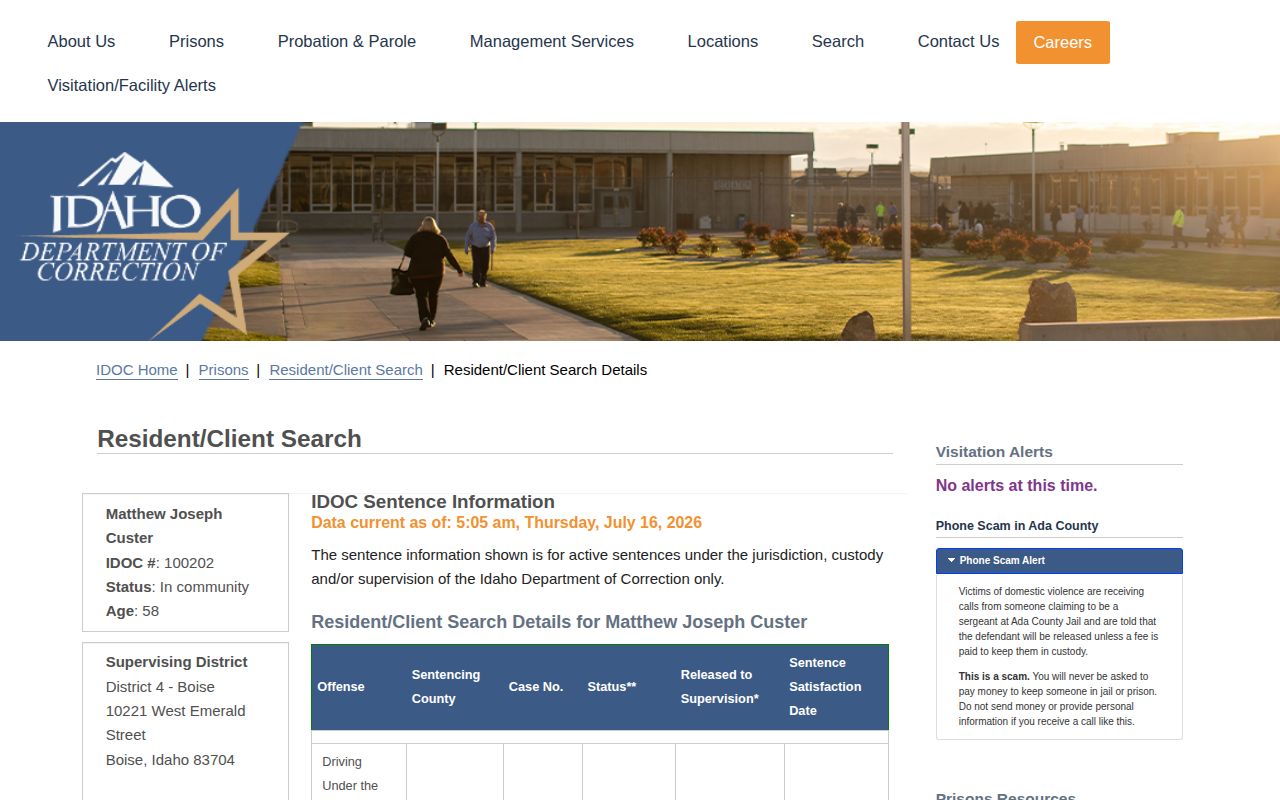
The layout separates status, sentence, case, and supervision dates. It should not be used to focus on the example person shown.
No Custer 85 Percent Shortcut
The distinctive Idaho rule is the absence of a generic 85 percent estimate. Fixed and indeterminate terms, jail credit, concurrent or consecutive structure, enhancements, and narrow statutory exceptions control the computation. A Commission date remains tentative until required programming and a parole plan are approved. That makes percentage arithmetic especially unreliable for a Custer County case.
County jail sentences need separate treatment. No official local calculation policy was found in the reviewed Custer sources. Obtain the judgment from the court and the jail calculation from the sheriff. State-prison parole arithmetic should never be imported into a local misdemeanor term.
A useful request identifies the person, case number, booking range, judgment date, and the exact milestone sought. For the court, ask for the judgment and later amended orders. For the sheriff, ask for the jail calculation and the completed release entry. For IDOC, ask for the sentence computation or public portions that explain scheduled termination, credit, and term structure. This record-by-record method avoids mixing a court forecast with an actual custody event.
Timing evidence should also be dated. An IDOC result is updated daily, a Commission notice reflects a decision stage, and VINE reflects an event feed. Save the source date and verify again near the expected release. A hold from another agency can mean departure from one custodian without community release. If the sheriff record says transfer, obtain the receiving agency before choosing another locator.
Custer Date Sources by Custody
The Custer County Sheriff's Office is closest to a local jail checkout. Its booking and release sheet can document the date, time, authority, release type, and destination if those fields are maintained and public. The Custer County court file explains the legal event behind release, such as bond, dismissal, judgment, sentence completion, or an amended order. Neither source should be replaced by an IDOC estimate when the person served only a local term.
IDOC becomes relevant after state commitment. Its public result can show In custody, In community, Discharged with a date, or Active Bench Warrant. A detail record can include sentencing county, case number, offense, sentence, and supervision-related dates. A person may leave prison and remain In community for years before final discharge. That is why “out of prison” and “sentence complete” cannot be used as synonyms.
Federal and immigration records form separate layers. A local transfer entry may point to another county, IDOC, a federal custodian, or immigration custody. In that event, the Custer departure date is actual but it is not a community release date. Identify the receiving agency from the sheriff or court record, then use the matching locator. A no-result response from an unrelated database does not resolve custody.
When the records disagree, do not average the dates. Ask each custodian what event its field represents and when it was last updated. A later filed order can control over an older portal entry. An actual release timestamp can confirm departure even if a forecast remains visible elsewhere. Keep the agency response, court order, and search date together so the chronology can be checked without turning a tentative milestone into a false claim of release.