
Custer Parole and Probation
Parole and probation both permit a person to live in the community under rules, but they arise at different points. Probation is imposed by a court. It may be the main sentence or may follow a period in jail. Parole is a conditional release from the indeterminate part of an Idaho prison sentence and is granted by the Idaho Commission of Pardons and Parole. The Commission makes release decisions. The Idaho Department of Correction Division of Probation and Parole supervises state parole and felony probation in the community.
Custer County adds an important local split. Adult misdemeanor probation has a county officer, while felony probation and parole fall within IDOC District 7. A jail release entry alone does not identify which office has authority. Start with the judgment and case level. Then match the record to the office in charge.
| Record type | How it begins | Custer County authority |
|---|---|---|
| Misdemeanor probation | County court judgment | Custer County Adult Misdemeanor Probation |
| Felony probation | District Court judgment | IDOC District 7 |
| Parole | Commission grant after prison eligibility | Commission decides; IDOC District 7 supervises |
| Discharge | Sentence or supervision ends | Confirm in the originating court or IDOC record |
- Parole
- Conditional community release during the indeterminate portion of a state sentence.
- Probation
- Court-ordered community supervision, sometimes imposed instead of or after confinement.
- Discharge
- Completion of the sentence or supervision jurisdiction.
- Absconder
- A supervised person whose whereabouts are unknown and who has stopped reporting as required.
Verify Custer Post-Release Supervision
No single public search gives a complete answer for every Custer County case. The IDOC Resident/Client Search is the first state source when felony probation, parole, or a state commitment is plausible. Results may show In community, In custody, Discharged with a date, or Active Bench Warrant. IDOC updates the search daily but warns that status and location can change fast. A county misdemeanor case may not appear there at all.
- Identify the court case and whether the charge level is misdemeanor or felony. Use the Idaho iCourt Portal for the docket, then obtain the filed order from the clerk when the exact judgment matters.
- Search IDOC by last name and optional first name, or by IDOC number. Compare birth year, middle name, case, and sentencing county before relying on a match.
- Read the status precisely. In community means the person remains in IDOC jurisdiction outside prison. Discharged means the IDOC sentence was satisfied.
- For misdemeanor probation, contact the county officer. For felony probation or parole, contact IDOC District 7 and provide the identifying case or IDOC number.
- For parole timing, check the Commission's decision notice. Treat any parole date as tentative until actual release is confirmed.
Custer Supervision Office Split
The case level determines the right contact. Custer County identifies Aletia Straub Workman as its Adult Misdemeanor Probation Officer. The local office handles adult misdemeanor supervision imposed through the county court. It does not replace IDOC for felony probation or parole. Those state cases belong to District 7, whose main office is in Idaho Falls and which also uses satellite coverage for a broad eastern Idaho region.
801 E. Main Ave., Challis, ID 83226
P.O. Box 385, Challis, ID 83226
(208) 879-3312
astraub@co.custer.id.us
Monday through Friday, 8 a.m. to 5 p.m.
2225 W. Broadway St., Suite A
Idaho Falls, ID 83402
(208) 528-4220
Give the office enough detail to distinguish the person and case. A name alone can lead to a false match. A case number, IDOC number, date of birth, and sentencing county are more useful. The office can address its own supervision record, but the filed court judgment remains the best source for the sentence imposed.
Custer Supervision Status Changes
Conditions are the rules attached to probation or parole. They can include reporting, approved residence, treatment, travel limits, financial obligations, or other case-specific terms. The public docket may show the judgment and later violation filings, but it may not list every working instruction given by an officer. Conditions differ by case. Do not infer them from another person's order.
A violation allegation is not the same as a final revocation. The court decides probation consequences. The Commission handles parole revocation matters. Outcomes can include reinstatement, a period of confinement followed by a return to parole, revocation with more prison time, a new tentative date, or service to full term. When IDOC displays Active Bench Warrant, it signals an unresolved warrant status in that state record. An absconder has stopped required contact and cannot be located by supervision staff. The listed office and current court record are the proper verification channels.
Idaho VINE may help with custody-change alerts after an arrest or transfer, but it is not a full supervision ledger. County jail and IDOC feeds are distinct. Registering on one record should not be assumed to follow the person across both systems.
Custer Supervision and Discharge
Supervision can end when the controlling sentence reaches discharge, when the court enters an order that changes or ends probation, or when the state record reflects completion of IDOC jurisdiction. The words matter. IDOC defines “Released to Supervision” as the most recent placement on supervision by a court or the Parole Commission. That date is not final discharge. An In community result also means jurisdiction continues.
For a state case, look for Discharged and its date in the IDOC result, then request the underlying record if formal proof is needed. For county misdemeanor probation, obtain the relevant court order and confirm status with the local officer. The Custer County released inmate search paths explain how sheriff release records, court orders, and state correction records fit together. They should agree on identity and custody layer before a supervision conclusion is made.
Under Idaho's Public Records Act, a narrow request to the record custodian is stronger than a broad demand for every file. Some material may be withheld or redacted under law. Ask for reasonably segregable public portions and the legal basis for any withholding.
Which Custer Office Has Authority?
Custer County's named misdemeanor officer and IDOC District 7 serve different legal tracks. This is the distinctive local issue in a supervision check. A person convicted of a county misdemeanor may report locally even though an IDOC search returns nothing. A person on felony probation or parole may live in Custer County while the state district office holds the supervision record. The place of residence does not change which sentence created authority.
Use the case caption and judgment first. Magistrate Court generally handles misdemeanor and traffic matters, while District Court handles felony matters. If a case moved between courts or includes more than one file, check each controlling order. Contacting the wrong office can yield a truthful “no record” that still fails to answer the broader question.
Custer Parole Decision Records
The Commission hearing schedule and hearing and review decisions document the decision stage for state parole. The schedule can change. The Commission posts hearing order after the prior session closes, and its current process calls for weekly schedule postings on listed dates. A Notice of Action Taken is generally posted by the end of Friday after an individual's hearing.
The official schedule shows how the Commission organizes names and IDOC numbers. It is interface evidence, not proof of release. A grant carries a tentative date. Required programming and an approved parole plan must be complete before final release.
See the official Commission calendar before relying on a hearing date.
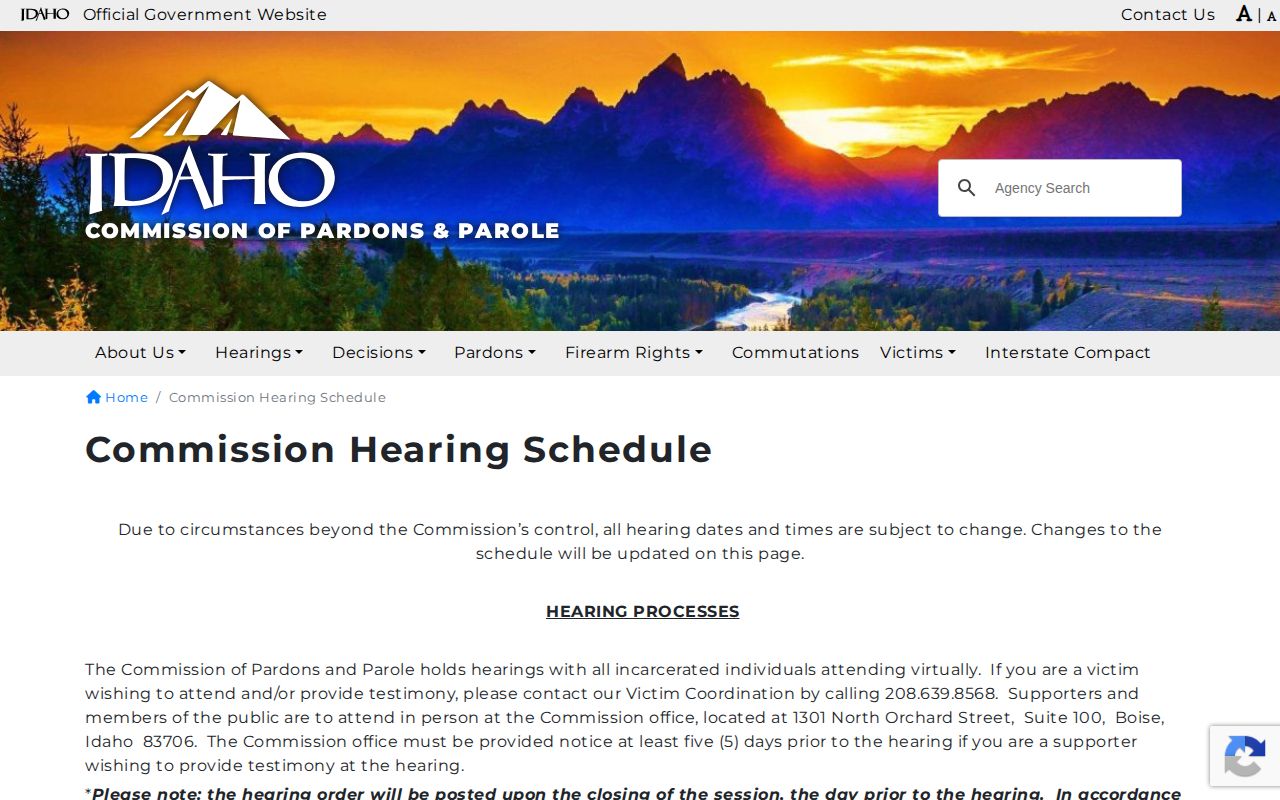
The calendar helps locate the decision process, while IDOC status, VINE, and the release record confirm what happened afterward.